

Turn your community evidence into decisions.
An AI-driven analytics tool that helps local-authority commissioners and public health teams spot community health and social-care trends from aggregated service data.
Who it's for
Built for commissioners and analysts, not just dashboards.
Community Intelligence brings your organisation’s evidence (reports, engagement records, needs assessments) into one shared library, then gives commissioners and analysts deterministic, no-AI dashboards over it: how your evidence maps against the CQC Key Lines of Enquiry, where coverage gaps sit by population group or engagement method, what’s been cited most, and where safeguarding concerns have been flagged.
It’s being developed by IO Analytics for Bloom Health, in response to a “Vibrant & Healthy Communities” commissioning brief for exactly this kind of capability: predictive analytics and natural-language insight over aggregated community data.
Upload once
Read, indexed and tagged automatically, not by hand.
Every document is read and indexed the moment it’s uploaded, so Companion can search it straight away. The same pass detects document type, business area, tags, equity dimensions, ward and date from the content itself, so nobody fills in a tagging form first. Every AI-suggested field stays reviewable and editable afterward, and a person’s own edit is never overwritten by a later suggestion.

Ask Companion
Grounded answers, with sources, not a black box.
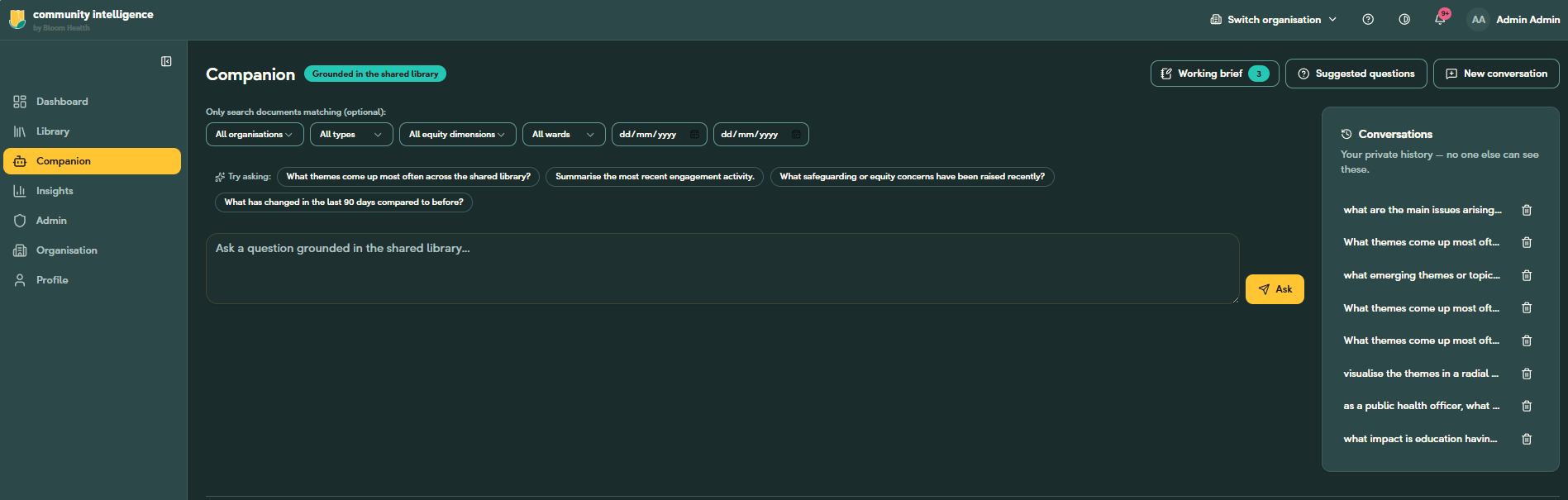
Companion answers natural-language questions directly against your organisation’s own shared library. Every answer carries a “Grounded in the shared library” badge and cites the documents it drew from, so you can check the source rather than take the answer on trust. Questions can be scoped by organisation, document type, equity dimension, ward and date range, so an answer only draws on exactly the evidence that matters.
A “Working brief” builds up across a conversation as you go, so a session’s worth of findings can be pulled together into one document rather than copied out answer by answer. Conversation history is private to each user by default, so no one else on the account can see what you’ve asked.
Try asking:
Inside the product
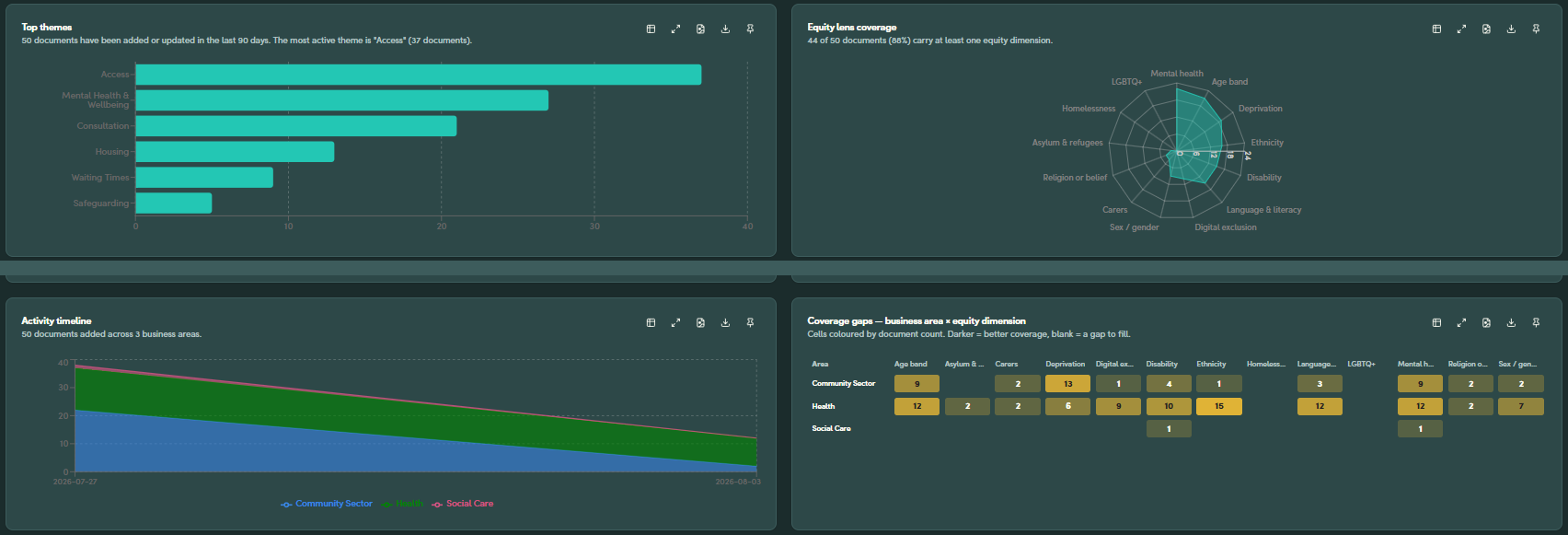
The real dashboards
Deterministic counts over the shared library, no AI involved, updated live. A real screenshot below, from a deployment with real (if modest) data in it. Not a mockup, and not invented figures.
Governed, not just answered
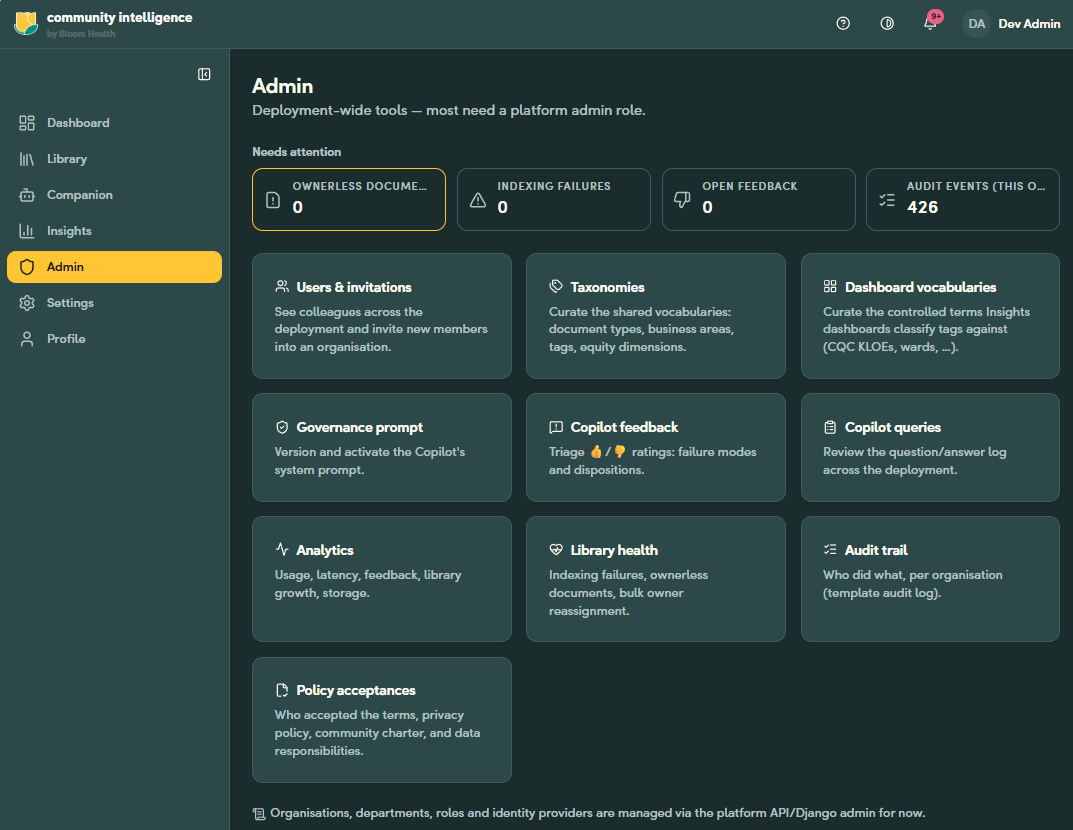
An admin console sits behind the dashboards: shared vocabularies and the Copilot's own system prompt are curated by an admin rather than hardcoded, every answer's feedback is triaged, and an audit trail records who did what, per organisation.
Built for public-sector teams
Usable by everyone on the team, not just the confident reader.
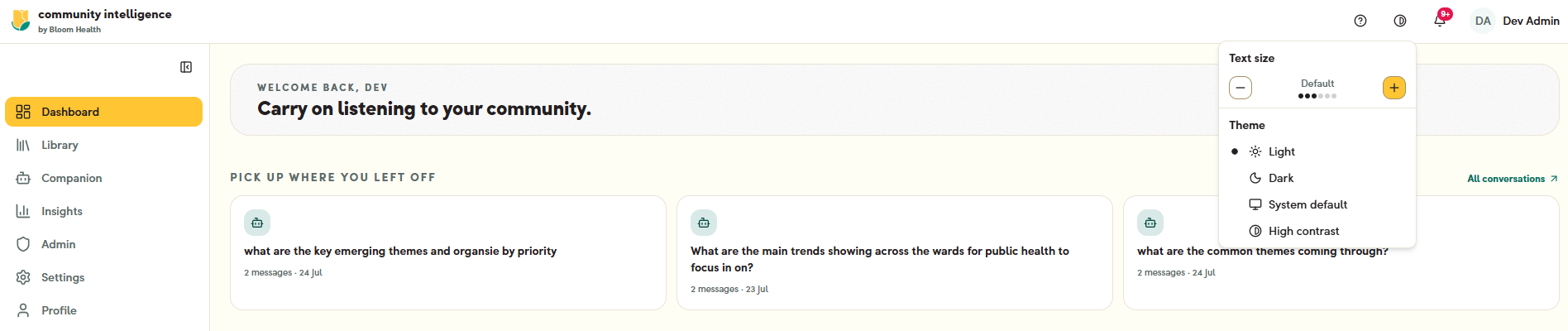
Text size adjusts across six steps, from Smallest to Largest, and the colour theme switches between Light, Dark, System default and a genuine High Contrast mode, not just a darker dark mode. Both apply everywhere in the product and are remembered per person, so the tool adapts to the reader rather than the other way round.
This sits on top of a wider WCAG 2.2 AA commitment: semantic HTML, full keyboard support, clear form labels and visible focus states throughout, tested for screen-reader and low-vision use, not just this one settings menu.
Insights support – not replace – professional judgement.
Proven in partnership
Spanning local government, health and the third sector.
Currently in use with One Westminster and Kensington & Chelsea Social Council, as part of a wider multi-organisation partnership in London.

Interested in Community Intelligence?
We're developing this with local-authority and public-sector partners – get in touch to talk about your area.
The downloadable one-pager is aimed at third-sector and community organisations specifically, including its own commercial model – the rest of this page speaks to local-authority and public-sector teams.